
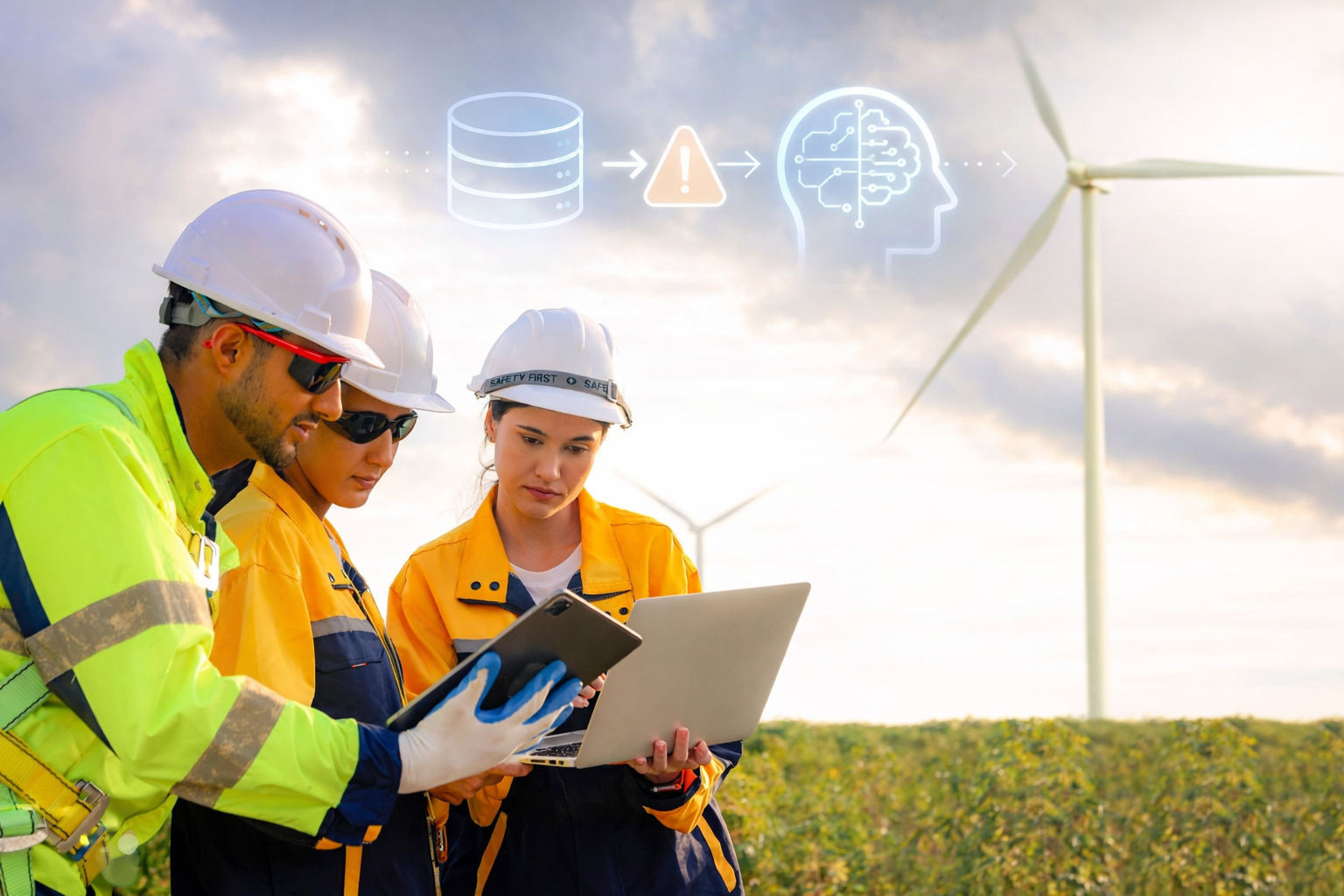
Everyone I talk to wants AI in field service. Predictive maintenance, automated insights and
conversational interfaces for technicians. Who wouldn’t want it? The potential is real.
But after years of seeing these projects succeed and fail, I can tell you this with confidence:
Most failed AI projects in field service fail long before any model is deployed.
AI doesn’t fail because it’s immature. It fails because the data feeding it isn’t trustworthy.
The Uncomfortable Truth About Field Data
AI is only as good as the data it learns from. And field data is some of the hardest data to get right. Why?
- It’s captured under pressure
- Conditions are unpredictable
- Inputs vary by technician
- Context is often missing
- Structure is lacking
I’ve seen AI models trained on inspection data where every technician captured the same information differently. The system technically had “data,” but it didn’t have truth.
The result wasn’t intelligence. It was noise.
AI is trained to make its best educated guess, so if your data is inconsistent or missing, you’re likely going to get hallucinations or bad/incorrect responses.
The Data AI Actually Needs
For AI to work in field service, data needs to be:
- Structured
- Contextual
- Validated
- Captured in real time
That means decisions can’t wait until after the job is closed. Validation can’t happen days later. And “close enough” isn’t good enough anymore.
This is where guided data capture becomes the foundation for AI, not the flashy layer on top.
Conversational and Hands-Free Isn’t the Point, Accuracy Is
There’s a lot of excitement around conversational data capture, image recognition, and hands-free workflows. And those things matter.
But they only matter if the data remains accurate.
When conversational input is paired with structured logic, validation rules, and real-time feedback, it becomes incredibly powerful. Technicians can work naturally, without sacrificing data quality. That’s when AI stops being experimental and starts being operational.
The goal isn’t AI for the sake of AI. The goal is efficient confidence in the outcome.
Salesforce + Youreka: Preparing for What’s Next
Salesforce gives organizations an incredible platform for analytics, automation, and AI. But it depends entirely on what’s fed into it.
Youreka ensures that field teams capture data that’s actually usable for reporting today and AI-driven workflows tomorrow.
Not someday. Not after cleanup. Immediately.
That’s how you build toward Agentforce, Einstein, and predictive service without rework.
AI isn’t something you turn on. It’s something you prepare for.
Next: why intelligent documentation and reporting are the final — and most overlooked — step.
AI in field service is a topic I spend a lot of time discussing, especially where expectations and reality don’t always line up.
If you’re exploring AI, Agentforce, or analytics in Salesforce and want to compare notes on what actually works, feel free to connect with me on LinkedIn. I’m always happy to share what I’ve seen in the field.