
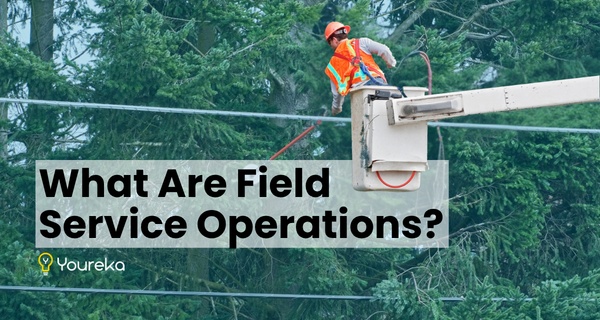
Field service operations are the day-to-day activities a company performs to deliver service away from its own facilities — installations, maintenance, inspections, and repairs carried out at a customer’s site. Many teams still run these operations on paper, spreadsheets, or a patchwork of disconnected tools, which leads to delays, errors, repeat visits, and limited visibility into what is actually happening in the field.
This guide breaks down what field service operations involve, why they have grown more complex, where they break down today, and what a modern, mobile-first approach looks like in practice.
Why Field Service Operations Have Become More Complex
They have become more complex because customers expect faster, more accurate service while the work itself — and the workforce behind it — keeps changing.
A few forces are driving this. Workforces are more distributed, so coordinating technicians across regions is harder than it used to be. Equipment is more sophisticated, raising the bar on technician skill and documentation. And an aging, retiring workforce is walking out the door with institutional knowledge that is rarely written down. Leaders feel the downstream impact as slower decision-making, inconsistent reporting, and limited visibility — even when frontline teams are working as hard as ever.
What Slows Down Field Service Operations Today
Most of what slows down field service operations comes down to friction in how data moves between the field and the office.
The usual culprits are familiar. Paper-based processes mean information is captured once on site, then re-entered later into systems like Salesforce — duplicate work that invites errors and delay. Scheduling and dispatch conflicts send the wrong technician, or the right technician without the right parts. Communication between dispatchers and technicians breaks down, so status updates arrive late or not at all. And inconsistent workflows across teams make it nearly impossible to compare performance or spot problems early.
Underneath all of this is a timing problem: when data is not captured in real time at the source, every downstream decision is based on stale information. Tools that were never designed for mobile or offline environments make it worse. Together, these gaps point to the need for a more modern, standardized approach to running field operations.
Field Service Operations vs. Field Service Management: What’s the Difference?
There is no single, universally agreed field service definition, but a practical field service definition is this: field service is any work performed for a customer outside your own premises. Field operations are the hands-on activities that deliver that work, while field service management is the broader coordination of the people, processes, and technology that make it happen.
In other words, the field service definition describes the what, operations describe the doing, and management describes the orchestrating. That field service definition has also broadened over time, as more industries — from manufacturing to utilities to healthcare — now send skilled people into the field. Returning to that field service definition makes the focus clear: anchoring every team to one field service definition tells you where to invest. Improving field service operations is usually about execution and data, while field service management is about visibility and control across the whole service lifecycle.
The Core Components of Field Service Operations
At a high level, field service operations are made up of a handful of connected components that move a job from request to resolution.
Those components typically include scheduling (deciding who does what and when), dispatch (getting the right technician to the right site), work order management (tracking the job from creation to close), inventory and parts (making sure technicians arrive equipped), mobile execution (capturing data and completing the job on site), and reporting (turning completed work into insight). None of these stand alone. A weak handoff in one stage — a missed part, a late dispatch — ripples through the rest, which is why high-performing teams treat the work as a single end-to-end flow rather than a series of separate tasks.

Common Challenges in Field Service Operations
The most common challenges show up as repeat visits, missed commitments, and rising costs.
Recurring problems include repeat truck rolls when a technician arrives without the right part or information, SLA breaches caused by poor coordination, and data silos that hide the true state of operations. Each one is individually manageable, but together they compound: every avoidable second visit adds cost, frustrates customers, and erodes trust. The good news is that most of these challenges trace back to the same root cause — disconnected data — which means they can be addressed systematically rather than one fire at a time.
What Is a Field Service Management System?
A field service management system is software that centralizes and coordinates field operations in one place — scheduling, dispatch, work orders, inventory, mobile data capture, and reporting.
Rather than stitching together spreadsheets, email, and paper, a field service management system connects the office and the field so information flows in real time. Dispatchers can see technician availability and job status; technicians can access customer history and capture data on site; and managers get reliable reporting instead of reconciling numbers from disparate sources. The best field service management system is built for the realities of field work — mobile-first, able to function offline, and integrated with the systems of record a business already uses. A capable field service management system also standardizes how data is captured, so every job produces clean, comparable information. When a field service management system is doing its job, it becomes the operational backbone that the rest of your field service operations run on.
Field Service Operations Best Practices
The strongest field service teams share a few habits, regardless of industry.
They use dynamic scheduling to match the right technician to the right job in real time, rather than relying on static, manual planning. They equip technicians with mobile access to job details, customer history, and standardized forms so work is consistent and complete. They automate administrative tasks — work orders, invoicing, follow-ups — to free up time for actual service. And they collect feedback from both technicians and customers to find friction before it becomes a pattern.
Why Mobile, Offline-Capable Data Capture Matters in the Field
Reliable field service operations depend on capturing data at the source — and field teams frequently work where connectivity is limited or nonexistent.
Basements, remote sites, rural infrastructure, and large facilities all create dead zones. If a tool stops working the moment a technician loses signal, the result is the same old workaround: jot it on paper now, key it in later. That reintroduces every problem digitization was supposed to solve. Mobile, offline-capable data capture lets technicians keep working uninterrupted, then automatically syncs once connectivity returns. The data is recorded accurately, in the moment, and flows into the system of record without manual re-entry. For organizations serious about improving field operations, this capability is not a nice-to-have — it is foundational.
How Youreka Supports Field Service Operations
Modern field operations come down to one thing: capturing accurate data in the field and putting it to work across the business. That is exactly the gap Youreka is built to close.
Youreka brings structured, mobile-first data collection — including full offline capability — directly into the Salesforce ecosystem, so the information your technicians capture is reliable, consistent, and instantly usable. The result is fewer repeat visits, cleaner reporting, and better visibility across your field service operations.
Ready to see it in action? Book a demo, or download our Field Data Capture Buyer’s Guide for 2026 to go deeper.
Frequently Asked Questions
What are field service operations?
Field service operations are the activities a company performs to deliver service at a customer’s location, such as installation, maintenance, inspection, and repair.
What is the difference between field service and field service management?
Field service is the work performed at a customer site; field service management is the coordination of the people, processes, and technology that deliver it.
What is a simple field service definition?
A simple field service definition is any service work performed for a customer outside your company’s own facilities, such as installation, maintenance, inspection, or repair.
What is a field service management system?
A field service management system is software that centralizes scheduling, dispatch, work orders, inventory, mobile data capture, and reporting in one platform.
What are the biggest challenges in field service operations?
The biggest challenges in field service operations include repeat truck rolls, scheduling conflicts, poor field-to-office communication, manual data entry, and data silos.
How do you improve field service operations?
Improve field service operations by standardizing workflows, adopting dynamic scheduling, equipping technicians with mobile tools, and capturing data digitally at the source.